
How Costa Mesa Residents Are Found
A Costa Mesa resident search works best when the first step matches the clue. An address belongs in the Orange County Assessor and the county GIS viewer. A deed trail belongs in RecorderWorks, where party names and recording details lead to instrument references. A current voter question belongs in the California registration gateway or Orange County’s self-verification service, not in a public name list. An older household may surface in a directory, census schedule, newspaper, yearbook, or obituary. The Costa Mesa residents directory is made from these separate record types, each kept for a different public purpose.
There is no complete public household roll. An assessor result is an ownership or assessee lead, not a list of people at the address. Voter tools confirm a person’s own status and do not offer anonymous street browsing. Directories may omit people who did not subscribe or who were missed by a compiler. The clean approach is to keep the question narrow and preserve the source’s role.
- Write down the exact name, address, unit, or old label and decide whether the goal is a current person, an owner, or a past household.
- Search the Orange County Assessor by address or APN, then use the GIS parcel map to confirm the parcel and its neighboring lots.
- Use the county recorder’s party index for a deed, lien, or other instrument, checking both grantor and grantee roles.
- Use voter status only for the permitted verification path, then compare court, vital, business, license, or obituary evidence when the question requires it.
- For a missing city file, older deed, or restricted copy, ask the responsible office, library, or archive through its documented request channel.
Costa Mesa Records Offices
Costa Mesa is an incorporated city inside Orange County, not a separate county records jurisdiction. City Hall handles municipal files such as permits, planning, contracts, agendas, and police-record routing. The Orange County Clerk-Recorder handles recorded property documents and county vital copies. The Assessor supplies parcel and assessment information, while the Registrar of Voters controls election records. California agencies and the state courts add statewide or case-specific material.
That division prevents a common mistake: asking the city for a deed, or treating a tax portal as a title office. Costa Mesa’s public-records form says building-permit researchers should try Document Search first. Police-report requests go to the Police Records Bureau at 714-754-5373 rather than through the city’s web form. For a general city record, the CPRA form asks for a clear description, contact details, and useful identifiers such as an address, APN, project number, or date span.
Orange County Clerk-Recorder
601 N. Ross Street
Santa Ana, CA 92701
714-834-2500
Orange County Assessor
Parcel and assessment records
Address and APN search
Public portal
Orange County Registrar
1300 S. Grand Ave., Building C
Santa Ana, CA 92705
714-567-7600
Orange County Archives is the local history fallback at the Old Orange County Courthouse in Santa Ana. It is open for reference work Monday through Friday from 9 a.m. to noon and 1 to 4:30 p.m.; call 714-834-2536 before traveling. The Donald Dungan Library and OCPL genealogy resources fill a different role by leading to directories, yearbooks, newspapers, and licensed research databases.
Costa Mesa Assessor to APN
The parcel is the safest bridge between a modern address and older records. Start with the Orange County Assessor’s public search using the house number and street name, or an APN when one is known. The GIS map adds a visual check. It can help distinguish a target parcel from a nearby lot with a similar number, show adjoining polygons, and connect the parcel to legal-description clues.
Record the situs address separately from the owner’s mailing address. Situs means the physical property label. Mailing address means where assessment notices go. A difference may reflect an owner who receives mail elsewhere, a trust, an entity, or a routine mailing preference. It does not prove that the owner is absent, and a match does not prove every resident is an owner.
- Address keys
- House number, street name, full address variants, and unit information where exposed.
- Parcel keys
- APN, old APN, subdivision, legal block, lot, and book-page cues in the city parcel service.
- Assessment fields
- Land, improvement, and total assessed value, use or type, tax-rate area, and exemption indicators.
- Ownership clues
- Assessee or owner display, mailing fields, sale and prior-sale details where the municipal layer exposes them.
A few terms keep the records trail clear. A parcel is the mapped piece of land tied to an APN. A roll is an official list kept for a defined purpose, such as assessment or registration. An index points to a record, while an image or certified copy is the underlying evidence. A criss-cross directory is an address-order directory that can identify a subscriber or occupant rather than only an alphabetical name.
The assessor is not a title guarantee. The Treasurer-Tax Collector’s search is for secured tax bill and payment status. The city parcel feature service is unusually rich, but its schema still requires careful reading because a field that describes a sale or lender is not the same as a current resident record.
Why Costa Mesa Owners Are Not Residents
Costa Mesa’s owner-occupancy estimate is 39.6 percent for 2020 through 2024. That local number gives the lookup a useful reality check: a parcel owner can be important evidence without being a substitute for a resident directory. A tax mailing address may be out of town. A trust or company may appear in a record. A household may include people who never appear in title documents.
Use the owner record to form a lead, then ask what independent source can confirm the question. A voter result is limited to an authorized purpose or personal status check. A city permit names applicants and contractors, not necessarily occupants. A directory or census schedule may identify a household, but it may also reflect a past date and a publisher’s coverage choices. Evidence should be labeled by date and role.
Current Costa Mesa Resident Directories
Current resident directories in Costa Mesa are really a set of narrower rolls. The Orange County Assessor is strongest for parcel and ownership clues. The voter status gateway is strongest for a person checking their own registration. RecorderWorks reveals parties to recorded instruments. City, business, license, and community pages identify official or organizational connections, not a complete list of households.
| Source | Who or what it covers | Keeper | Access |
|---|---|---|---|
| Assessor parcel search | Assessee, situs, mailing and value clues | Orange County Assessor | Free public search |
| Voter status gateway | Personal registration and election status | California SOS / Orange County | Identity match required |
| RecorderWorks | Parties, dates, types and document references | Orange County Clerk-Recorder | Free index; copies separate |
| City Services Directory | Official departments and employee contacts | City of Costa Mesa | Free online directory |
| Business and organization pages | Public affiliation or contact channel | SOS, Chamber, city programs | Scope varies; no household roster |
These categories are useful because they keep a lookup honest. A business address is not a home address. A license is an affiliation record. A city staff page identifies someone in an official role. A community group may publish a contact route while keeping its members private. When the task shifts from mapping sources to verifying one person, the Costa Mesa resident lookup workflow pairs the right record types without merging them.
| Source type | Best use | Limit to remember |
|---|---|---|
| Official parcel, deed, voter, and court sources | Trace a named role, date, parcel, registration status, or public case event | Each source has a defined purpose and may omit occupants or protected records |
| Library, archive, newspaper, and directory collections | Recover past households, address changes, relatives, and local context | Coverage depends on publication, place label, compiler, and surviving volume |
| Commercial people-finder category | Only a possible lead for a name or address to verify elsewhere | Data can be stale, merged, incomplete, or unclear about its source |
Costa Mesa RecorderWorks Resident Trail
The Orange County online grantor-grantee index is a resident trail because recorded documents attach names to land, but it is not a directory of occupants. Search by grantor or grantee name, recording date or range, document title or type, and instrument number when known. A grantor transfers an interest; a grantee receives one. Searching both roles matters when a deed chain moves backward.
RecorderWorks is an index, not an image viewer. The county says it will not perform a title search over the phone, in person, or by mail. For a copy, identify the document number. County guidance uses a year plus a six-digit instrument number for 1982-forward references. Older copy requests need book, page, and instrument references when available. Plain copies are $1 per page, and certification adds $1 per document or map on the county’s copy page.
A parcel link is stronger than a matching name alone. Compare the legal description, instrument date, deed type, and parties. A quitclaim, trustee’s deed, reconveyance, lien, or family transfer does not carry the same meaning as an ordinary purchase. The county’s free courtesy notice program mails the property owner a notice with the first page for specified title-affecting documents. It is a fraud warning, not a public resident alert.
For a street-by-street chain, move from the parcel to the owner lead, then from the owner to the recording index. The detailed address method belongs on the Costa Mesa street directory page.
The recorder screenshot below comes from the live Orange County grantor-grantee index. It illustrates the index route, while the county’s copy instructions govern what happens after a document number is found.
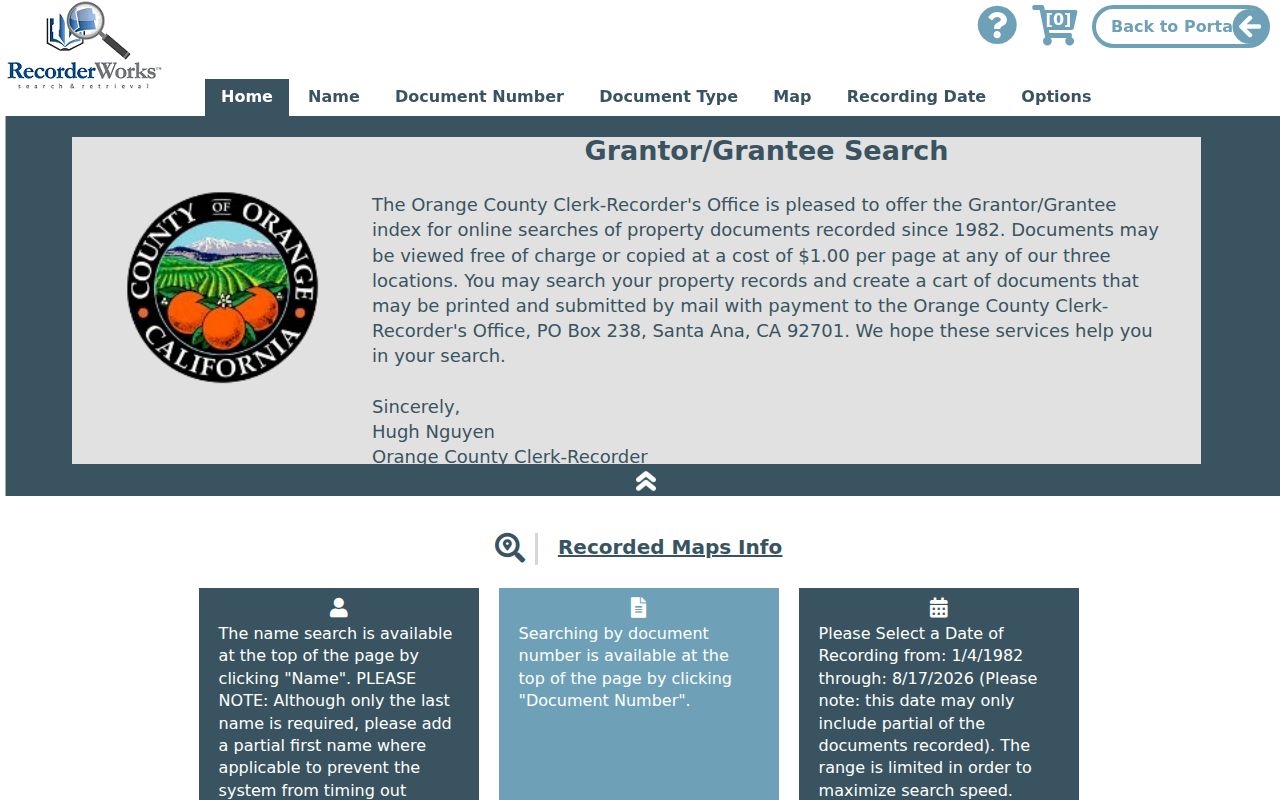
Because the index does not include document images, a result is a lead to verify through the Clerk-Recorder’s copy process rather than a finished title record.
Costa Mesa Voter Lookup Is Verification
California’s public voter-status form asks for identity details such as first name, last name, date of birth, and an additional driver-license, state-ID, or Social Security digit field depending on the route. That design is deliberate. VoteCal and the Orange County self-lookup service let a voter check their own registration, party preference, polling or vote-by-mail details, and ballot status. They do not provide an anonymous Costa Mesa resident list.
| Field or control | Role in the lookup | Public result boundary |
|---|---|---|
| First and last name | Matches the registration record | Not an open browse field |
| Date of birth | Identity verification | Used to match, not published as a directory result |
| License, ID, or SSN digits | Additional identity check | Portal-dependent and protected |
| County or address | Routes or confirms the record | Not a street-enumeration tool |
The full voter file is limited by Elections Code §§2187 and 2194 and 2 CCR §19003. Authorized purposes include election, scholarly, journalistic, political, or approved governmental use; commercial use is prohibited. A qualified file request may carry a fee and requires a stated purpose. Protected participants and specified confidential officials may have withheld information. Never infer a permanent move from an inactive status or a failed self-check.
Costa Mesa Court and License Cross-Checks
A name search becomes more reliable when each source contributes a different fact. Orange County Superior Court case access is split by case type. A public docket may show case number, caption, party roles, filing date, courthouse, department, hearings, register-of-actions events, status, and disposition. It may not show the underlying documents. The Costa Mesa Justice Complex at 3390 Harbor Boulevard can help with case-specific questions; call 657-622-8452 and confirm the correct justice center before visiting.
Use the court name with care. A filing is an allegation until resolved, and a dismissal is not a conviction. The court’s L-3009 request form is a fallback for a records search or copy when the web service is not enough. It asks for requester contact information, justice-center selection, case or citation number if known, party or case information, the requested record, delivery details, and signature. Advance payment applies, and confidential or juvenile records have restrictions.
Business and professional sources answer a narrower question. California bizfile can connect an entity to its number, status, formation date, jurisdiction, agent, address, and filings. The county FBN system can identify a registrant using a fictitious business name. Department of Consumer Affairs search can filter by board, license type or number, name, city, county, status, and discipline where the board exposes those fields. Those results show an official affiliation, not a residence.
The Orange County Superior Court case-access page shows why a Costa Mesa residents directory should separate court events from address evidence. A court result can corroborate a name and date, but the record’s status and confidentiality rules still control.
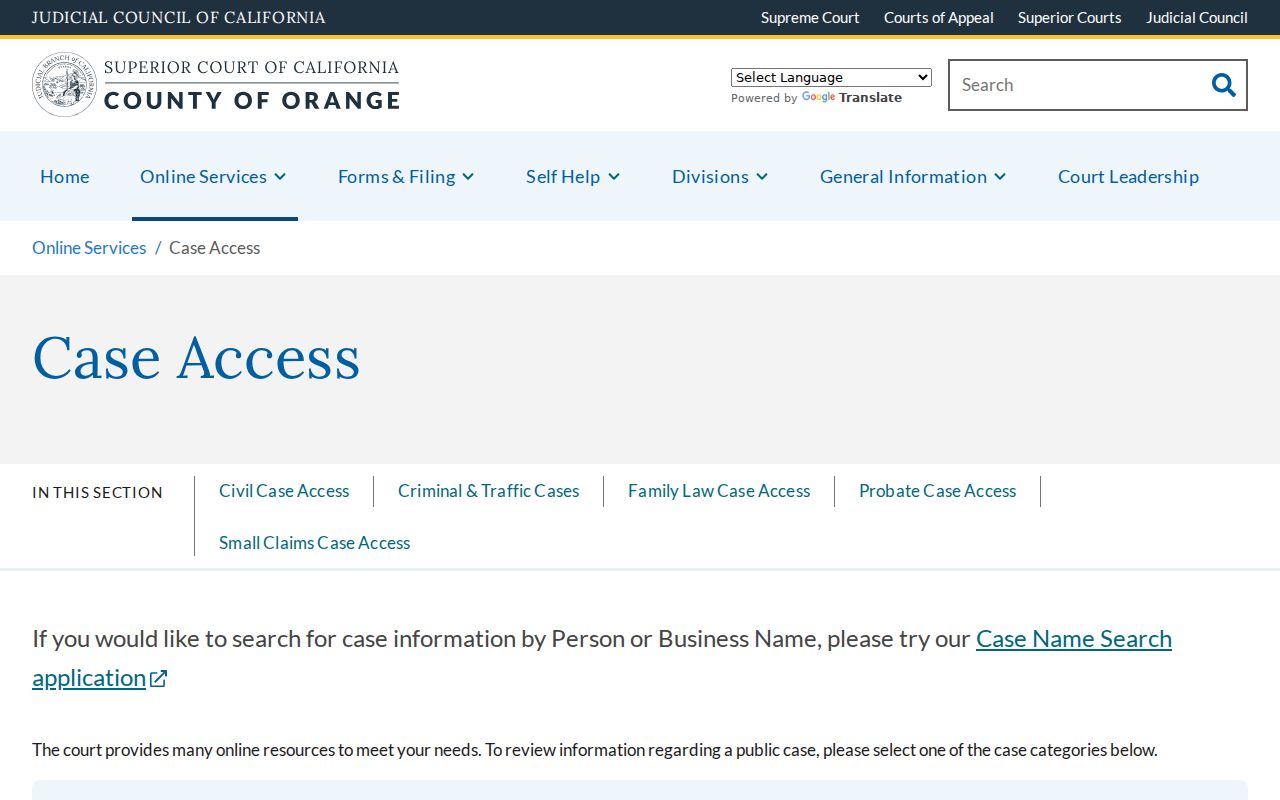
Use case number, party role, filing date, and disposition together when a public docket is available. Do not treat a name match alone as identity proof.
Costa Mesa Vital Records Lookup
California vital records do not follow one simple rule that makes every certificate public after a set number of years. The key distinction is between an authorized certified copy and an informational certified copy. Authorized copies can establish identity for a qualifying requester. Informational copies are certified but marked as not valid to establish identity. Birth, death, and marriage copies can come from the Orange County Clerk-Recorder for county events or from California Department of Public Health for statewide service.
- Birth
- CDPH VS 111; 2026 state fee $31; eligibility and sworn-statement rules apply.
- Death
- CDPH VS 112; 2026 state fee $26; informational and authorized access differ.
- Public marriage
- CDPH VS 113A; 2026 state fee $19; confidential marriages follow a separate rule.
- Dissolution
- CDPH VS 113B; 2026 state fee $18; a certificate is not the Superior Court judgment.
Confidential marriage records are limited to a party or court order under Family Code §509. Adoption records are sealed except through the statutory or court process. Mailed authorized-copy applications generally require a sworn statement and notarization. An index entry is a finding aid, not proof of every fact on a certificate. Historical indexes, newspapers, cemetery records, census pages, and FamilySearch collections can suggest a lead, but the custodian controls the official copy.
The California vital-record forms page lists the application routes. It is the right starting point when a Costa Mesa name lookup needs a life-event record rather than an address clue.
When Costa Mesa Records Go Offline
Online access is only one channel. A city permit that is not in Document Search may still be requested by exact address, permit or project number, record type, and date range through the Costa Mesa CPRA process. Ask for the existing permit jacket, inspection history, final record, or certificate of occupancy rather than asking staff to create a new resident list. Plans and security-sensitive details can have inspection or copy limits.
County property copies follow a separate route. Search RecorderWorks yourself, then send the document number or older book-page-instrument reference to the Clerk-Recorder with a self-addressed stamped envelope and payment. The office’s public page lists the copy charge and the 714-834-2500 number for copy questions, but staff do not perform the title search. Orange County Archives can answer historical-government questions by reference inquiry or in person. OCPL can search catalog variants for Costa Mesa, Newport Harbor, Santa Ana, Orange County, telephone directories, reverse directories, newspapers, and yearbooks.
California’s Public Records Act, Government Code §§7920.000–7931.000, is the broad fallback for identifiable nonexempt city or state agency records. Any person may request. An agency generally has ten calendar days to determine whether it has disclosable records, with a written extension of up to fourteen days for unusual circumstances. That determination window is not a promise that production will be finished in ten days. Ask for existing records, narrow dates, and a clear custodian.
The city’s online public-records request form explains how the responsible department handles inspection, copies, exemptions, and clarification. It is the documented fallback when a Costa Mesa municipal record is not indexed in the city archive.
Historical Costa Mesa Resident Directories
Historical Costa Mesa resident directories require flexible place labels. The area appears under Newport in an 1884 regional directory, under broader Santa Ana or Orange County titles in other runs, and under Costa Mesa more consistently as the city and its mail labels changed. A local study sampled directory years from 1951 through 1988, with entries filed under Santa Ana through 1968 and Costa Mesa beginning in 1969. Searching only the modern city name can hide the household you want.
The Costa Mesa Historical Society’s resource collection includes directories, phone books, yearbooks, maps, newspapers, clipping files, and oral histories. Its 1978 oral-history project recorded interviews with 45 residents across Harper-era families, wartime and postwar arrivals, business founders, and early city government. The Donald Dungan Library is the practical first stop for catalog and genealogy help, while Orange County Archives supplies older government and local-history context. Directory entries can provide a name, spouse notation, occupation, telephone, and address; a reverse section can turn an address into a subscriber lead.
Pair the directory shelf with census schedules, deeds, permits, obituaries, and family papers. A directory disappearance could mean a move, death, nonpublication, a missed listing, or a changed street label. The dedicated Costa Mesa city directory page traces the collections and the label changes in greater detail.
Costa Mesa’s Old Directory Labels
Costa Mesa’s records geography follows local history. Orange County separated from Los Angeles County in 1889, so a pre-1889 search may need Los Angeles County-era material. The 1901 Old Orange County Courthouse now houses the History Center and Archives. Costa Mesa incorporated on June 29, 1953, and later annexations added the Fairgrounds and Mesa del Mar, Orange Coast College, west-of-Harbor land, and northern acreage. An older address can therefore predate a Costa Mesa municipal file even when the modern street name looks familiar.
Directory makers also left a human record. Bessie Lounsberry compiled local names and addresses from 1937 to 1951 without pay. The 1941-42 and 1943-44 material captured household head, wife, children, occupation, telephone, and address, while 1958 added employer fields. Those details can connect a family to a place, but they reflect the compiler’s method and the publication year. Use the printed volume and page as the evidence, not just a search-result snippet.
Costa Mesa History Sources for Resident Research
The Historical Society is more than a photograph archive. Its listed holdings include more than 27,000 photographs, over 1,000 books, hundreds of maps, directories and phone books, yearbooks, oral histories, and newspaper or clipping files. Named material includes Early Costa Mesa, the Mildred Fisher school years, Santa Ana Army Air Base, Dodge, Ed Miller, and Lions Club collections. Appointments are listed for Thursday and Friday reference hours, and the society can help with local context that a national database will miss.
Its newspaper work adds a strong name trail. The documented runs include Costa Mesa Herald, Globe, Globe-Herald, Costa Mesa News, Independent, selected Daily Pilot years, Newport Ensign, and Newport Balboa Press. OCR can reveal an obituary, business notice, meeting item, or address event, but volunteers should confirm access mode and the original page. Orange Coast College Archives, the Orange County California Genealogical Society, Huntington Beach Central Library, the Orange FamilySearch Center, NARA Riverside, and California State Archives provide additional channels when a local shelf is thin.
Historical research is strongest when it explains a gap rather than hiding it. Costa Mesa does not have a verified online, year-by-year directory shelf list in the available research. Ask OCPL or the Archives to confirm the title, publisher, year, and page before stating that a particular volume exists. That caution keeps a Costa Mesa residents directory useful without turning an unverified catalog guess into a fact.
To check the county archive source used for this local-history trail, visit the Orange County Archives holdings page. A source image is paired with the archive discussion so the collection lead can be checked at its keeper.
Costa Mesa Fraud Alerts and Lookup Limits
Records can help with family history, civic research, a property question, or checking an unexplained filing. They should never become a reason to threaten, stalk, impersonate, trespass, or expose a protected address. California’s Safe at Home program provides qualifying participants with a substitute mailing address. The absence of a normal address can be a safety feature, not proof that someone moved.
Orange County’s recorder automatically mails a free courtesy notice for specified title-affecting documents, including the first page. That notice helps a property owner spot a deed-fraud concern. The county has also warned about intercepted property-tax checks and promoted its official no-fee electronic payment path. Verify payment and document instructions with the custodian instead of trusting a call, letter, or paid middleman.
Lawful personal use. Costa Mesa public records are for legitimate research and civic transparency. Do not use a lookup to stalk, harass, intimidate, or harm a person, and respect confidentiality programs and custodian corrections.
If a result is wrong, keep the instrument, APN, case, license, or certificate reference and contact the office that created it. A directory can point to the record, but only the custodian can correct or certify the source.
The RecorderWorks search and the California voter-status gateway show why source-specific limits matter. The former is a free recorded-document index without images; the latter is identity-based self-verification. Together they make a better Costa Mesa residents directory workflow than either one used as a universal list.
The voter-status screenshot below comes from the official California registration-status service. It represents a personal verification channel, not an open Costa Mesa neighborhood roster.
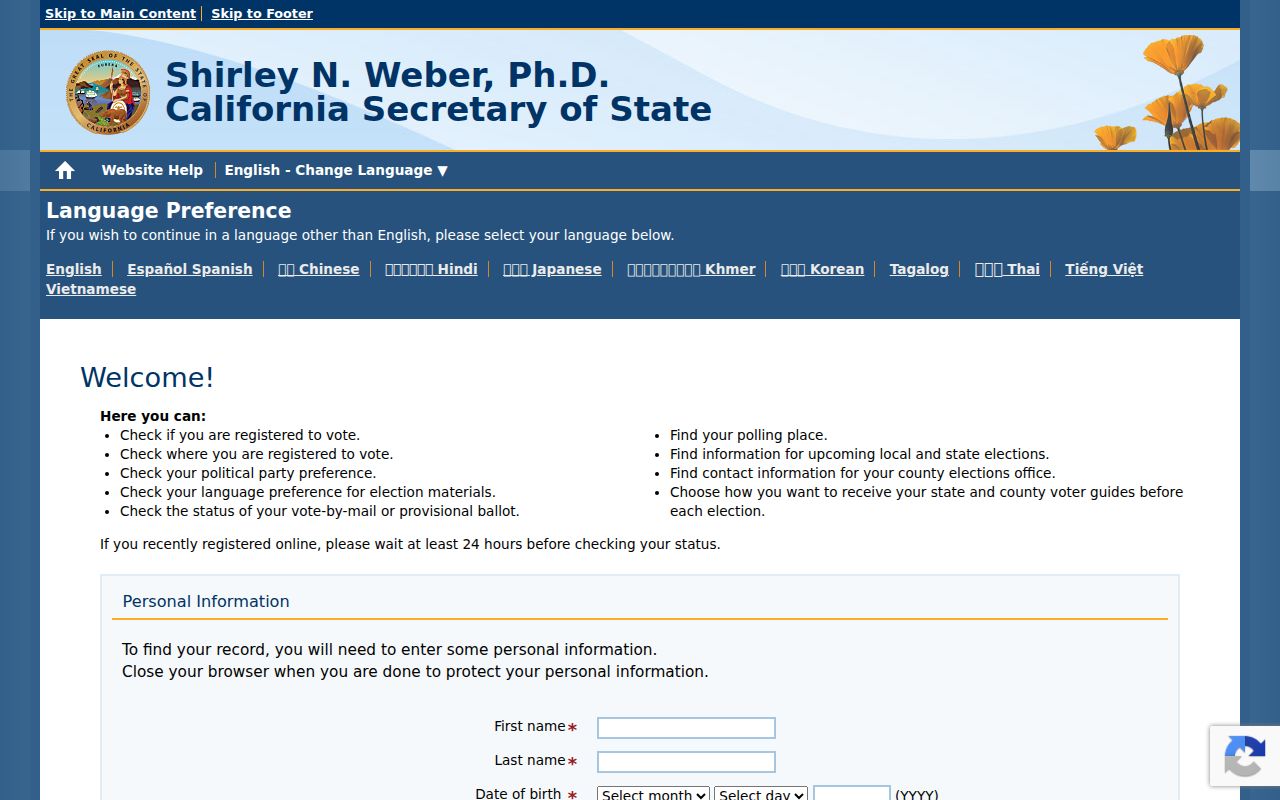
Use the official form’s matching fields and respect the purpose limits on voter-file requests; an unsuccessful self-check does not establish that a person left Costa Mesa.