
The Costa Mesa City Directory Shelf
An official year-by-year shelf list for Costa Mesa was not verified, so a neat Polk run should not be assumed. The evidence points to a distributed trail: an 1884 regional volume files the area under Newport; a 1931 Costa Mesa Herald shop directory supplies a local marker; Bessie Lounsberry compiled names and addresses from 1937-51; and later material may be filed under Orange County, Santa Ana, Newport Harbor, telephone, reverse, or criss-cross titles. The sampled city-study years are useful leads, not proof that every volume is on one shelf. Confirm each title, year, and access condition before citing it.
| Collection | Years | Where Held | Access |
|---|---|---|---|
| 1884 regional directory, area filed under Newport | 1884 | Costa Mesa Historical Society reference holdings | Ask for title and page confirmation |
| Costa Mesa Herald shop directory | 1931 | Costa Mesa Historical Society reference holdings | Local reference inquiry |
| Bessie Lounsberry local names and addresses | 1937-51 | Costa Mesa Historical Society | Confirm volume and access appointment |
| Expanded Costa Mesa entries | 1941-44 | Historical Society directory holdings | Confirm the volume and page |
| City-study sampled directory years | 1951, 1955, 1958-59, 1962-64, 1966-70, 1972, 1974, 1980, 1984, 1986, 1988 | Local catalog and archive inquiry | Use as a year lead, not a shelf claim |
| Orange County, Santa Ana, Newport Harbor, telephone, reverse, and criss-cross labels | Collection-specific | OCPL, Archives, and genealogy collections | Search catalog variants |
| Digitized city and business directories | Collection-specific | FamilySearch catalog and partner access | Account, affiliate, or rights check |
The gaps matter. The research does not verify a complete run, a final printed year, a publisher sequence, or a stable online image set for Costa Mesa alone. The city study places addresses under Santa Ana through 1968 and under Costa Mesa from 1969, but that filing shift should not be mistaken for a publication start or a municipal boundary change. A catalog search should therefore record the exact title, publisher if printed, year, page, reel or image number, and holding institution. If a result is described only as “Orange County” or “telephone,” keep that label in the citation.
Where Costa Mesa City Directories Are Held
The Donald Dungan Library is part of Orange County Public Libraries. Its genealogy gateway is the practical first stop for catalog help and licensed research databases. Ask staff to search beyond “Costa Mesa”: include Orange County city directories, Santa Ana, Newport Harbor, telephone directories, reverse directories, school yearbooks, local newspapers, maps, vertical files, and community histories. Some databases can be branch-only or library-card gated, and availability can change, so the current library page controls access.
For a post-incorporation address clue, start with Costa Mesa Document Search before treating a permit or project file as a directory substitute. If the needed city file is absent, the city's online public-records request form routes the request to the responsible department, which can explain inspection, copy cost, and any CPRA exemption. These records can point to an address or date, but they are companion evidence rather than a printed resident roll.
Orange County Archives is the government-history fallback. The research address is the Old Orange County Courthouse, Room 108, 211 W. Santa Ana Blvd., Santa Ana, with telephone 714-834-2536. Published reference hours are Monday through Friday, 9 a.m. to noon and 1 to 4:30 p.m.; the archive closes at lunch. The directions page includes a route from Costa Mesa. Call before traveling and ask whether the desired directory, phone book, map, or county record is available for reference or reproduction.
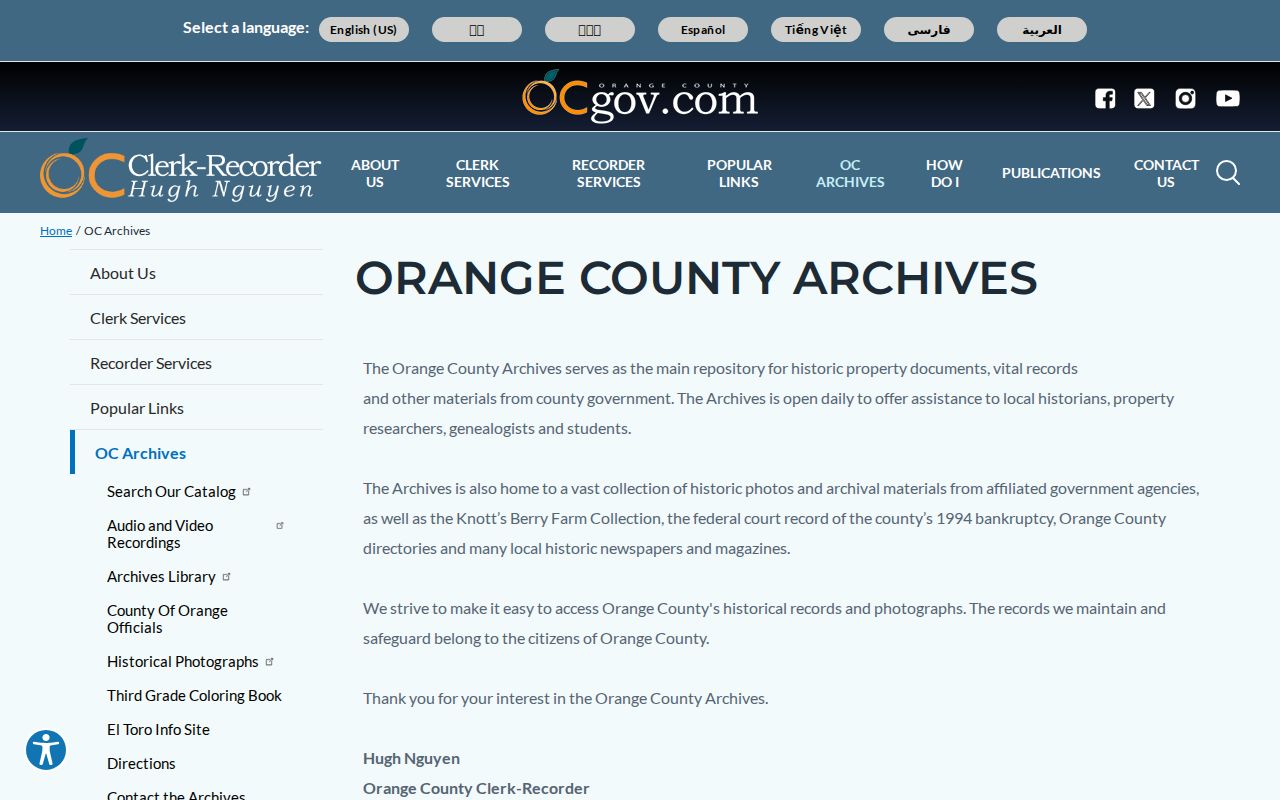
The Orange County Archives holdings page identifies the archive gateway used for local directory and county-history research. The screen capture below is a useful visual cue for the collection path, not proof that a particular Costa Mesa year is on the shelf.
For federal and digitized routes, the NARA Riverside facility supports Southern California census and other federal-record research. The FamilySearch city and business directory collection can be searched by place and record type, but an image may require a free account, a FamilySearch Center, an affiliate library, or rights-holder access.
Costa Mesa's Newport-Labeled Directories
Place names change the search. The Historical Society's 1884 Los Angeles County directory files the present Costa Mesa area under “Newport.” Orange County separated from Los Angeles County in 1889, so a pre-1889 search may need both the older county context and the Newport label. A missing Costa Mesa hit in an early directory is not enough to show that the person or place was absent.
The same problem continues in the twentieth century. The city study sampled addresses under Santa Ana through 1968 and under Costa Mesa beginning in 1969. Searchers should try Costa Mesa, Santa Ana, Newport Harbor, Orange County, telephone, reverse, and criss-cross as separate catalog terms. Preserve the title's own geographic label in notes, because it explains why a local person can appear under a neighboring place name.
Costa Mesa incorporated on June 29, 1953, while municipal records and directory labels developed on different tracks. Annexation and growth added Fairgrounds and Mesa del Mar, Orange Coast College, west-of-Harbor land, and northern acreage during the 1955-59 period. Those changes make a tract, street, or address clue useful, but they do not supply a verified directory run.
Other local eras make useful search terms: Fairview and Paularino agriculture in the 1880s, Harper renamed Costa Mesa around 1920, Santa Ana Army Air Base in 1942-45, Orange Coast College in 1948, and South Coast Plaza after 1967. A directory name can make more sense when paired with the era's school, farm, military, or business records.
Note: A directory label can reflect its filing system and publication era rather than the current Costa Mesa boundary or postal address.
Bessie Lounsberry and Costa Mesa Directories
Bessie Lounsberry personally compiled local names and addresses from 1937-51 without pay. That detail gives Costa Mesa's directory history a human source trail: the local material was not only a commercial annual product, but also the result of a resident recording the names and places that mattered in her community. The surviving reference should be treated as a historical compilation with its own limits, not as a complete count of every person in town.
The Historical Society directory-history record also documents what the 1941-44 entries captured: telephone, household head, wife, children, occupation, and address. In 1958, employer information was added. These fields support family history, address tracing, and context around a household, while still leaving room for omissions, name variants, and people who were not listed.
The Historical Society's broader collection helps fill those gaps. Its holdings include more than 27,000 photographs, over 1,000 books, hundreds of maps, directories and phone books, yearbooks, oral histories, and newspaper or clipping files. A 1978 oral-history collection contains interviews with 45 residents. The Society lists 1870 Anaheim Ave. and telephone 949-631-5918, with Thursday and Friday hours of 10 a.m. to 3 p.m. and appointments for some research.
Those numbers matter because a directory search can branch into a yearbook, clipping file, map, or oral history without leaving the local history context. Ask for the exact collection name and access condition, then cite the item rather than describing the Society's holdings as one searchable database.
The Society's study of Japanese Costa Mesans found roughly a dozen households in the 1920 census and more than 50 by World War II. That kind of change is why census, school, farm, and community records can recover people who appear only briefly in a Costa Mesa directory.
Costa Mesa Directory Milestones by Year
The known milestones form a research timeline, not a promise that every intervening year exists. Use each row to choose the next catalog term or archive question.
| 1884 | A regional Los Angeles County volume files the present Costa Mesa area under Newport. |
|---|---|
| 1889 | Orange County separates from Los Angeles County, changing the county context for later records. |
| 1931 | A Costa Mesa Herald shop directory provides a locally printed directory marker. |
| 1937-51 | Bessie Lounsberry compiles local names and addresses without pay. |
| 1941-44 | Documented entries include telephone, household head, wife, children, occupation, and address. |
| 1951-88 | A city study samples 1951, 1955, 1958-59, 1962-64, 1966-70, 1972, 1974, 1980, 1984, 1986, and 1988. |
| 1958 | Employer information is added to the documented local entry fields. |
| 1969 | The city study begins filing Costa Mesa addresses under Costa Mesa rather than Santa Ana. |
There is no verified official shelf list that turns these markers into a continuous annual sequence. A missing year belongs in the research notes as unverified, not as a guessed publisher run.
Read a Costa Mesa Directory Entry
No openly viewable, authoritative Costa Mesa-inclusive directory page was accessible for a defensible verbatim local sample. The field guide below therefore combines the documented 1941-44 and 1958 descriptions with the typical mid-century Southern California format noted in the research. A real citation should capture the title, publisher, year, page, and image or reel reference before interpreting any line.
| Printed identity | Surname, given name or initial, and often the household head in the 1941-44 material. |
|---|---|
| Family notation | Wife or spouse information, children in the expanded entries, and widow notation such as “wid” when used. |
| Address and telephone | Street address, with telephone recorded in the 1941-44 descriptions; a reverse section starts with street and house number. |
| Occupation and employer | Occupation appears in the 1941-44 entries, while employer information is documented as an addition in 1958. |
| Home or status mark | A home, owner, or renter notation may exist in a particular volume; record the mark and its key rather than assuming its meaning. |
A telephone subscriber is not necessarily every adult in a household. An entry can be personal, business, or a cross-reference, and publisher conventions vary. The printed line must be read with the surrounding page and the volume's own abbreviation key.
Costa Mesa Directory Marks and Terms
Small marks carry the most risk of over-reading. Define the record type before using an entry as evidence about a family, a person, or an address.
- Criss-cross directory
- The street-order part of a directory, arranged by street and house number, then showing a listed occupant or subscriber when the volume provides one.
- Householder index
- A name-focused listing built around the household head or primary entry, so it may not name every person connected with the address.
- Abbreviation key
- The volume's own legend for short forms, occupation terms, residence or business marks, and cross-references. Consult it before expanding a symbol.
- Reverse listing
- An address-first section that lets a researcher move from a street and number toward a listed occupant or telephone subscriber.
Note: “Reverse” and “criss-cross” can describe related address-order material, but the volume's title and key control the exact format.
Trace a Household Through Costa Mesa Directories
Directory research works best as a sequence of small comparisons. Start with one firm clue, then move across adjacent years and record each change. The goal is not to force a continuous story, but to show which source supports each step.
- Establish one known year and exact address from a deed, obituary, census, yearbook, or family paper. Record the source page before searching more broadly.
- Search the alphabetical section for each adult surname, given-name variant, maiden name, married name, and initial. Copy the entry as printed, including spouse, occupation, and abbreviations.
- Check the street or reverse section for the address and nearby numbers. This can expose a misspelled surname and add block context without claiming a complete household list.
- Move one volume earlier and one later, not only by decade. A first appearance, disappearance, or “removed to” note can bracket a change in place.
- Pair directory snapshots with the 1940 or 1950 census, deeds, voter registrations, and newspapers. Census ages and relationships can separate adults who share a name.
- Explain gaps before treating them as moves. Nonpublication, nonresponse, new construction, annexation, a street renaming, household consolidation, or a telephone listed under someone else can produce the same absence.
- Cite the scan or page image, not only a database transcription. Keep the directory label, title, year, and holding institution with the note.
When a historical address needs a modern parcel trail, continue with the Costa Mesa street directory workflow for APN, GIS, assessor, and deed connections. When a directory name needs a present-day identity check, use the Costa Mesa resident lookup path and compare more than one record type.
Pair Costa Mesa Directories with Other Records
A city directory is strongest when it bridges two other sources. Census schedules can supply age, birthplace, relationships, occupation, and an address for released years. National Archives city-directory research notes also show why older place labels and regional volumes deserve a catalog search rather than a single-name query.
Newspapers can add an obituary, social notice, business change, or address event. The Historical Society's local resources include newspaper and clipping files, while its oral histories preserve connections that may never appear in a directory line. Sanborn maps can add building footprint, use, material, and neighborhood context, but the Library of Congress Sanborn collection is not an occupant index and exact Costa Mesa sheets were not confirmed.
Orange County Archives and OCPL are the local fallback chain when a volume is not online: ask the library to search catalog variants, ask the archive to confirm a holding, and then check NARA Riverside or FamilySearch for a digitized or partner-held copy. Keep a note of access limits, because a catalog hit may lead to a branch login, a reading-room appointment, or a rights-controlled image rather than an open scan.