
How Costa Mesa Residents Are Found
Match the clue to the record and a Costa Mesa resident lookup gets much easier. An address points to the Orange County Assessor and the county GIS viewer. A deed trail belongs in RecorderWorks, where party names and recording details yield instrument references. Voter questions go to the California registration gateway. They can also go to the county's self-verification service, never to a public name list. Older households surface in directories, census schedules, newspapers, yearbooks, and obituaries. The Costa Mesa residents directory draws on these separate record types. Each is kept for its own public purpose.
No complete household roll exists. An assessor hit is an ownership lead, not a census of who lives there. Voter tools confirm a person's own registration and permit no anonymous street browsing. Directories skip people who never subscribed or whom a compiler missed. Keep the question narrow and respect what each source actually records.
- Write down the exact name, address, unit, or old label and decide whether the goal is a current person, an owner, or a past household.
- Search the Orange County Assessor by address or APN, then use the GIS parcel map to confirm the parcel and its neighboring lots.
- Use the county recorder’s party index for a deed, lien, or other instrument, checking both grantor and grantee roles.
- Use voter status only for the permitted verification path, then compare court, vital, business, license, or obituary evidence when the question requires it.
- For a missing city file, older deed, or restricted copy, ask the responsible office, library, or archive through its documented request channel.
Costa Mesa Records Offices
Costa Mesa is an incorporated city within Orange County, not its own records jurisdiction. Municipal files such as permits, planning documents, contracts, agendas, and police-record routing stay with City Hall. The Orange County Clerk-Recorder holds recorded property documents and county vital copies. The Assessor supplies parcel and assessment data. The Registrar of Voters controls election records. California state agencies plus the state courts round out the picture.
That split prevents classic mistakes. Asking the city for a deed, or treating a tax portal as a title office, will not get you far. Costa Mesa's public-records form directs building-permit researchers to Document Search first. Police-report requests belong with the Police Records Bureau at 714-754-5373, not the web form. The general CPRA form asks for a clear description and contact details. Identifiers such as an address, APN, project number, or date span help too.
Orange County Clerk-Recorder
601 N. Ross Street
Santa Ana, CA 92701
714-834-2500
Orange County Assessor
Parcel and assessment records
Address and APN search
Public portal
Orange County Registrar
1300 S. Grand Ave., Building C
Santa Ana, CA 92705
714-567-7600
Orange County Archives is the local-history fallback. It is housed at the Old Orange County Courthouse in Santa Ana. Reference hours run Monday through Friday, 9 a.m. to noon and 1 to 4:30 p.m. Call 714-834-2536 before making the trip. The Donald Dungan Library and OCPL genealogy resources play a different role. They open doors to directories, yearbooks, newspapers, and licensed research databases.
Costa Mesa Assessor to APN
The parcel is the safest bridge between a modern address and older records. Begin with the Orange County Assessor's public search. Enter the house number and street name, or an APN if you have one. Add the GIS map for a visual check. It separates a target parcel from a neighboring lot with a near-identical number. It also displays adjoining polygons, and links the parcel to legal-description clues worth recording.
Keep the situs address and the owner's mailing address distinct. Situs labels the physical property. The mailing address is where assessment notices go. A mismatch may mean an owner who receives mail elsewhere, a trust, an entity, or simple preference. It never proves absence. Nor does a match prove every resident owns the home.
- Address keys
- House number, street name, full address variants, and unit information where exposed.
- Parcel keys
- APN, old APN, subdivision, legal block, lot, and book-page cues in the city parcel service.
- Assessment fields
- Land, improvement, and total assessed value, use or type, tax-rate area, and exemption indicators.
- Ownership clues
- Assessee or owner display, mailing fields, sale and prior-sale details where the municipal layer exposes them.
A few terms keep the trail clear. A parcel is the mapped land tied to an APN. A roll is an official list kept for one purpose, like assessment or registration. An index points to a record; the image or certified copy is the evidence itself. A criss-cross directory lists entries by address. So it can reveal a subscriber or occupant rather than only an alphabetical name.
The assessor is no title guarantee. The Treasurer-Tax Collector's search covers secured tax bills and payment status. The city parcel feature service is unusually rich, yet its schema still demands care. A field describing a sale or a lender is not a current resident record.
Why Costa Mesa Owners Are Not Residents
Owner-occupancy in Costa Mesa sits at an estimated 39.6 percent for 2020 through 2024. That figure matters for anyone using property rolls in a lookup. It means most parcels in the city do not house their owners. A tax mailing address can point to another town entirely. A trust or a company may hold title instead of a person. And a household often includes residents whose names never appear on a deed.
So treat an owner record as a lead, nothing more. Ask what independent source can confirm the question at hand. Voter rolls answer only for an authorized purpose or a person's own status. A city permit names applicants and contractors, not the people living there. A city directory or census schedule can sketch a household, yet it carries a past date and a publisher's coverage choices. Label every piece of evidence with its date and the role it proves.
Current Costa Mesa Resident Directories
There is no single book of current residents in Costa Mesa. What exists is a set of narrower rolls, each strong for one thing. The Orange County Assessor leads on parcel and ownership clues. The voter status gateway suits a person checking their own registration. RecorderWorks exposes parties to recorded instruments. City and business pages identify official ties. License and community pages do the same. None of them gives a complete list of households.
| Source | Who or what it covers | Keeper | Access |
|---|---|---|---|
| Assessor parcel search | Assessee, situs, mailing and value clues | Orange County Assessor | Free public search |
| Voter status gateway | Personal registration and election status | California SOS / Orange County | Identity match required |
| RecorderWorks | Parties, dates, types and document references | Orange County Clerk-Recorder | Free index; copies separate |
| City Services Directory | Official departments and employee contacts | City of Costa Mesa | Free online directory |
| Business and organization pages | Public affiliation or contact channel | SOS, Chamber, city programs | Scope varies; no household roster |
These categories keep a lookup honest. A business address is not a home address. A license is an affiliation record. A city staff page places someone in an official role. A community group may publish a contact route while keeping its members private. When the task shifts from mapping sources to verifying one person, the Costa Mesa resident lookup workflow pairs the right record types without blending them into something they are not.
| Source type | Best use | Limit to remember |
|---|---|---|
| Official parcel, deed, voter, and court sources | Trace a named role, date, parcel, registration status, or public case event | Each source has a defined purpose and may omit occupants or protected records |
| Library, archive, newspaper, and directory collections | Recover past households, address changes, relatives, and local context | Coverage depends on publication, place label, compiler, and surviving volume |
| Commercial people-finder category | Only a possible lead for a name or address to verify elsewhere | Data can be stale, merged, incomplete, or unclear about its source |
Costa Mesa RecorderWorks Resident Trail
Recorded documents attach names to land in Costa Mesa. That is why the Orange County grantor-grantee index works as a resident trail. It is not a directory of occupants. Search by grantor or grantee name. Search by recording date or range, by document title or type, and by instrument number when known. A grantor transfers an interest. A grantee receives one. Searching both roles matters whenever a deed chain runs backward.
RecorderWorks is an index, not an image viewer. The county will not run a title search by phone, in person, or by mail. For a copy, identify the document number first. County guidance calls for a year plus a six-digit instrument number for 1982-forward references. Older requests need book, page, and instrument references when available. Plain copies run $1 per page. Certification adds $1 per document or map on the county's copy page.
A parcel link beats a matching name alone. Compare the legal description, instrument date, deed type, and parties before drawing any conclusion. A quitclaim, trustee's deed, reconveyance, lien, or family transfer does not carry the meaning of an ordinary purchase. The county's free courtesy notice program mails the property owner a notice. It includes the first page for specified title-affecting documents. That is a fraud warning, not a public resident alert. For a street-by-street chain, start at the parcel. Follow the owner lead, then work the recording index. The detailed address method lives on the Costa Mesa street directory page.
The live Orange County grantor-grantee index shows the search route on its official page. Once a document number turns up, the county's copy instructions take over from there.
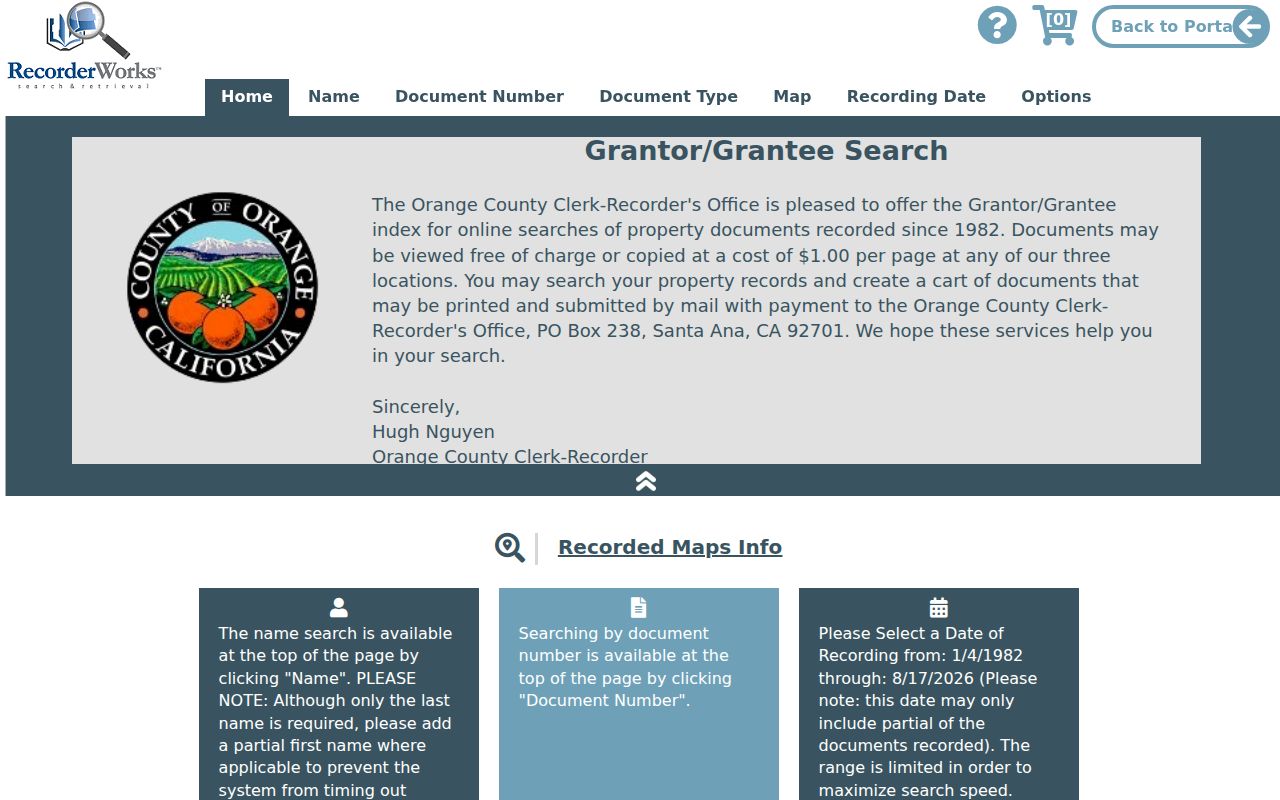
The index carries no document images. Every result is a lead to verify through the Clerk-Recorder's copy process, not a finished title record.
Costa Mesa Voter Lookup Is Verification
California's public voter-status form asks for first name, last name, date of birth, and, depending on the route, a driver-license, state-ID, or Social Security digit field. That design is deliberate. VoteCal and the Orange County self-lookup service let a voter confirm a registration, party preference, polling or vote-by-mail details, and ballot status. None of it amounts to an anonymous Costa Mesa resident list.
| Field or control | Role in the lookup | Public result boundary |
|---|---|---|
| First and last name | Matches the registration record | Not an open browse field |
| Date of birth | Identity verification | Used to match, not published as a directory result |
| License, ID, or SSN digits | Additional identity check | Portal-dependent and protected |
| County or address | Routes or confirms the record | Not a street-enumeration tool |
Elections Code §§2187 and 2194 and 2 CCR §19003 restrict the full voter file. Election, scholarly, journalistic, political, and approved governmental uses qualify. Commercial use is prohibited. A qualified file request may carry a fee and requires a stated purpose, and protected participants and specified confidential officials may have withheld information. Never read a permanent move into an inactive status or a failed self-check.
Costa Mesa Court and License Cross-Checks
A name is only a starting point. Different sources contribute different facts. Orange County splits Superior Court case access by case type. A public docket can list the case number, caption, party roles, filing date, courthouse, department, hearings, register-of-actions events, status, and disposition. The underlying documents may not appear. For case-specific questions, the Costa Mesa Justice Complex at 3390 Harbor Boulevard can help. Call 657-622-8452 first. Confirm the correct justice center before you go.
Read the court record with care. A filing is an allegation until it is resolved, and a dismissal is not a conviction. When the web service falls short, the court's L-3009 request form is the fallback for a records search or copy. It asks for requester contact information, a justice-center selection, case or citation number if known, party or case information, the requested record, delivery details, and a signature. Advance payment applies. Confidential and juvenile records carry restrictions.
Business and professional sources answer a narrower question. California bizfile can connect an entity to its number, status, formation date, jurisdiction, agent, address, and filings. The county FBN system can identify a registrant behind a fictitious business name. The Department of Consumer Affairs search filters by board, license type or number, name, city, county, status, and discipline where the board exposes those fields. Each result shows an official affiliation, not a residence.
The Orange County Superior Court case-access page shows why a Costa Mesa residents directory should separate court events from address evidence. A court result can corroborate a name and a date. But the record's status and confidentiality rules still control the outcome.
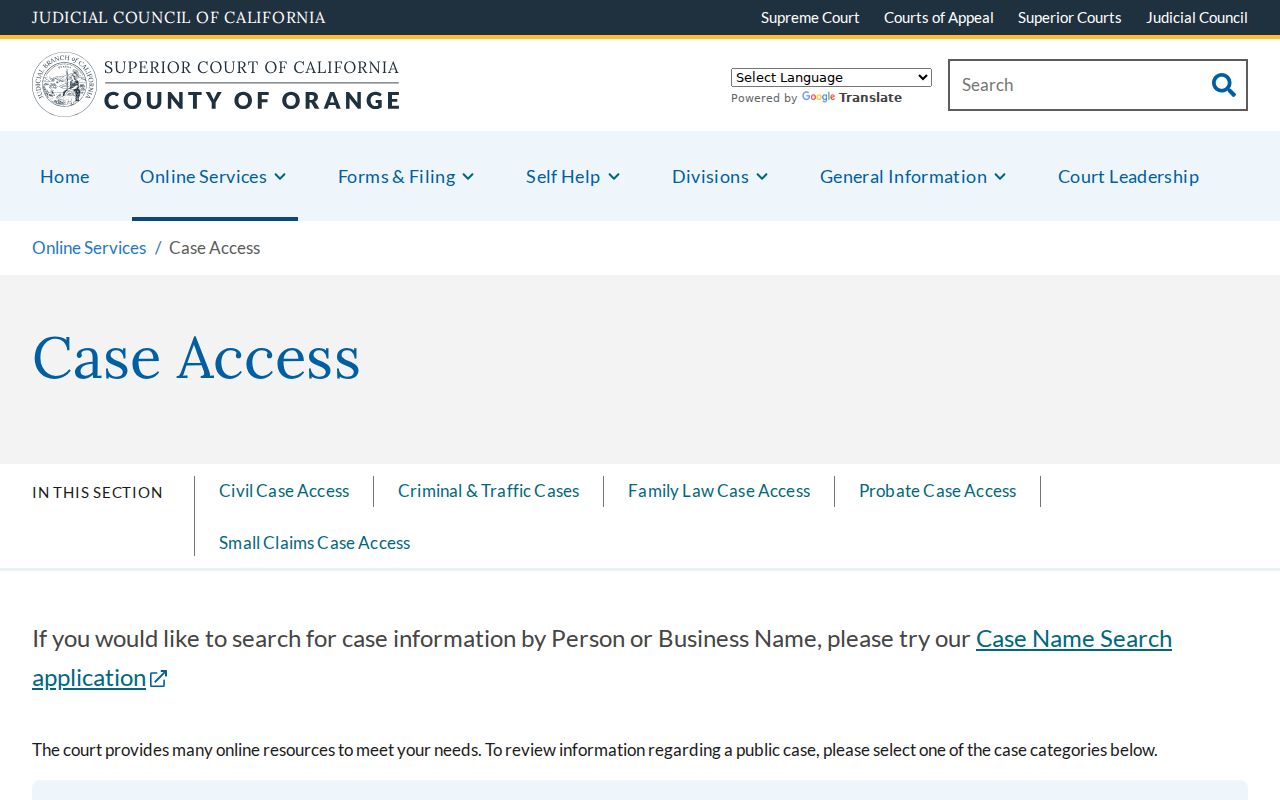
A public docket deserves a careful read. Combine case number, party role, filing date, and disposition when one is available, and never treat a name match alone as proof of identity in a Costa Mesa residents directory.
Costa Mesa Vital Records Lookup
California vital records follow no single rule. No rule opens every certificate to the public after a set span of years. The real distinction is between two copy types. Authorized copies establish identity for a qualifying requester. An informational copy is certified too. But it is marked as not valid to establish identity. Birth, death, and marriage certificates come from the Orange County Clerk-Recorder for county events. Statewide service runs through the California Department of Public Health.
- Birth
- CDPH VS 111; 2026 state fee $31; eligibility and sworn-statement rules apply.
- Death
- CDPH VS 112; 2026 state fee $26; informational and authorized access differ.
- Public marriage
- CDPH VS 113A; 2026 state fee $19; confidential marriages follow a separate rule.
- Dissolution
- CDPH VS 113B; 2026 state fee $18; a certificate is not the Superior Court judgment.
Confidential marriage records stay limited under Family Code §509. They are open only to a party or a court order. Adoption records stay sealed absent a statutory or court process. Mailed applications for authorized copies generally need a sworn statement and notarization. An index entry is a finding aid. It is not proof of every fact on a certificate. Historical indexes, newspapers, cemetery records, census pages, and FamilySearch collections can suggest a lead. But the custodian controls the official copy.
The California vital-record forms page lists the application routes. It is the right starting point. Use it when a Costa Mesa name lookup needs a life-event record rather than an address clue.
When Costa Mesa Records Go Offline
Online access is one channel among several. A city permit missing from Document Search can still be requested through the Costa Mesa CPRA process. Name the record type and date range. Include the exact address or permit or project number. Ask for the existing permit jacket, inspection history, final record, or certificate of occupancy rather than a new resident list. Staff cannot build one for you. Plans and security-sensitive details can carry inspection or copy limits.
County property copies follow a separate route. Search RecorderWorks yourself. Then send the document number, or an older book-page-instrument reference, to the Clerk-Recorder with a self-addressed stamped envelope and payment. The office's public page lists the copy charge and the 714-834-2500 number for copy questions. Staff do not perform the title search. Orange County Archives answers historical-government questions by reference inquiry or in person. OCPL can search catalog variants. Its holdings span Costa Mesa, Newport Harbor, Santa Ana, Orange County, telephone directories, reverse directories, newspapers, and yearbooks.
California's Public Records Act, Government Code §§7920.000–7931.000, is the broad fallback for identifiable nonexempt city or state agency records. Any person may request. An agency generally has ten calendar days to decide whether it holds disclosable records, with a written extension of up to fourteen days for unusual circumstances. That window is not a promise of finished production. Ask for existing records, narrow dates, and a clear custodian.
The city's online public-records request form explains how the responsible department handles inspection, copies, exemptions, and clarification. It is the documented fallback. Use it whenever a Costa Mesa municipal record sits outside the indexed city archive.
Historical Costa Mesa Resident Directories
Costa Mesa hid under other names for decades. An 1884 regional directory filed the area under Newport. Later volumes leaned on Santa Ana. Some leaned on broader Orange County titles. A local study sampled directory years from 1951 through 1988. Entries sat under Santa Ana through 1968. Costa Mesa headings begin in 1969. The modern name alone can hide your household.
The Costa Mesa Historical Society keeps directories, phone books, yearbooks, maps, newspapers, clipping files, and oral histories. Its 1978 oral-history project recorded 45 residents. They ranged from Harper-era families to wartime and postwar arrivals. Others were business founders and early city officials. The Donald Dungan Library is the practical first stop for catalog and genealogy help. Orange County Archives supplies older government context. A residents directory entry can give a name, spouse notation, occupation, telephone, and address. A reverse section turns an address into a subscriber lead.
Pair the directory shelf with census schedules, deeds, permits, obituaries, and family papers. A name can vanish for many reasons. A move, a death, or a missed listing explains it. So does a changed street label in a street directory index. The dedicated Costa Mesa city directory page traces the collections and label changes in detail.
Costa Mesa’s Old Directory Labels
Labels shift with local history in Costa Mesa records. Orange County split from Los Angeles County in 1889. Any earlier search may need Los Angeles County-era material. The 1901 Old Orange County Courthouse now houses the History Center and Archives. Costa Mesa incorporated on June 29, 1953. Later annexations brought in the Fairgrounds, Mesa del Mar, Orange Coast College, west-of-Harbor land, and northern acreage. An old address can therefore predate a Costa Mesa municipal file even when the street name looks familiar.
Directory makers also left a human record. Bessie Lounsberry compiled local names and addresses from 1937 to 1951 without pay. The 1941-42 and 1943-44 material captured household head, wife, children, occupation, telephone, and address. The 1958 volume added employer fields. Such details tie a family to a place, though they reflect the compiler's method and the publication year, so cite the printed volume and page rather than a search-result snippet.
Costa Mesa History Sources for Resident Research
The Historical Society is far more than a photograph vault. Its holdings include more than 27,000 photographs, over 1,000 books, and hundreds of maps. Directories, phone books, yearbooks, oral histories, and newspaper clipping files round out the shelves. Named collections cover Early Costa Mesa, the Mildred Fisher school years, Santa Ana Army Air Base, Dodge, Ed Miller, and Lions Club material. Early Costa Mesa fills one such group. So do the Mildred Fisher school years and the Santa Ana Army Air Base files. Dodge, Ed Miller, and Lions Club material complete the set. Reference hours run Thursday and Friday by appointment. Staff can offer local context a national database will miss.
Its newspaper files build a strong name trail. Documented runs include the Costa Mesa Herald, Globe, Globe-Herald, Costa Mesa News, and Independent. Selected Daily Pilot years sit nearby. So do the Newport Ensign and Newport Balboa Press. Newspapers notice people directories miss. OCR can surface an obituary, business notice, meeting item, or address event. Volunteers should confirm access mode and the original page before relying on a hit. Orange Coast College Archives and the Orange County California Genealogical Society offer more channels. Huntington Beach Central Library and the Orange FamilySearch Center add still more. NARA Riverside and California State Archives round out the list.
Good research explains a gap rather than hiding it. No verified online, year-by-year directory shelf list exists for Costa Mesa. Ask OCPL or the Archives to confirm the title. Publisher, year, and page should be checked too, before any volume is treated as real. A guess is not a source. That caution keeps a Costa Mesa residents directory useful. It stops a catalog guess from becoming fact.
Every local-history trail deserves a check at its keeper. Check the archive source behind this trail. Visit the Orange County Archives holdings page.
Costa Mesa Fraud Alerts and Lookup Limits
Records serve family history, civic research, and property questions. They can also flag an unexplained filing. They must never fuel threats, stalking, impersonation, trespass, or the exposure of a protected address. California's Safe at Home program gives qualifying participants a substitute mailing address. A missing address can be a safety feature. It is not proof that someone moved.
Orange County's recorder mails a free courtesy notice for specified title-affecting documents, first page included. That notice helps an owner spot a deed-fraud concern. The county has also warned about intercepted property-tax checks and promotes its official no-fee electronic payment path. Confirm payment and document instructions with the custodian rather than a call, letter, or paid middleman.
Lawful personal use. Costa Mesa public records are for legitimate research and civic transparency. Do not use a lookup to stalk, harass, intimidate, or harm a person, and respect confidentiality programs and custodian corrections.
Mistakes happen in any lookup. When a result looks wrong, save the instrument number, APN, case, license, or certificate reference. Then contact the office that holds the record. A residents directory can point you toward the right custodian. It cannot fix the source itself.
Source limits explain why one tool never fits every Costa Mesa search. The RecorderWorks search is a free recorded-document index with no images attached. The California voter-status gateway works differently, letting a person confirm only their own registration. Used together, they support a more reliable Costa Mesa residents directory workflow. Neither tool could do this on its own.
The status-check image below shows the official California registration-status service in action. Treat it as a personal verification channel. It is not an open roster of Costa Mesa neighbors.
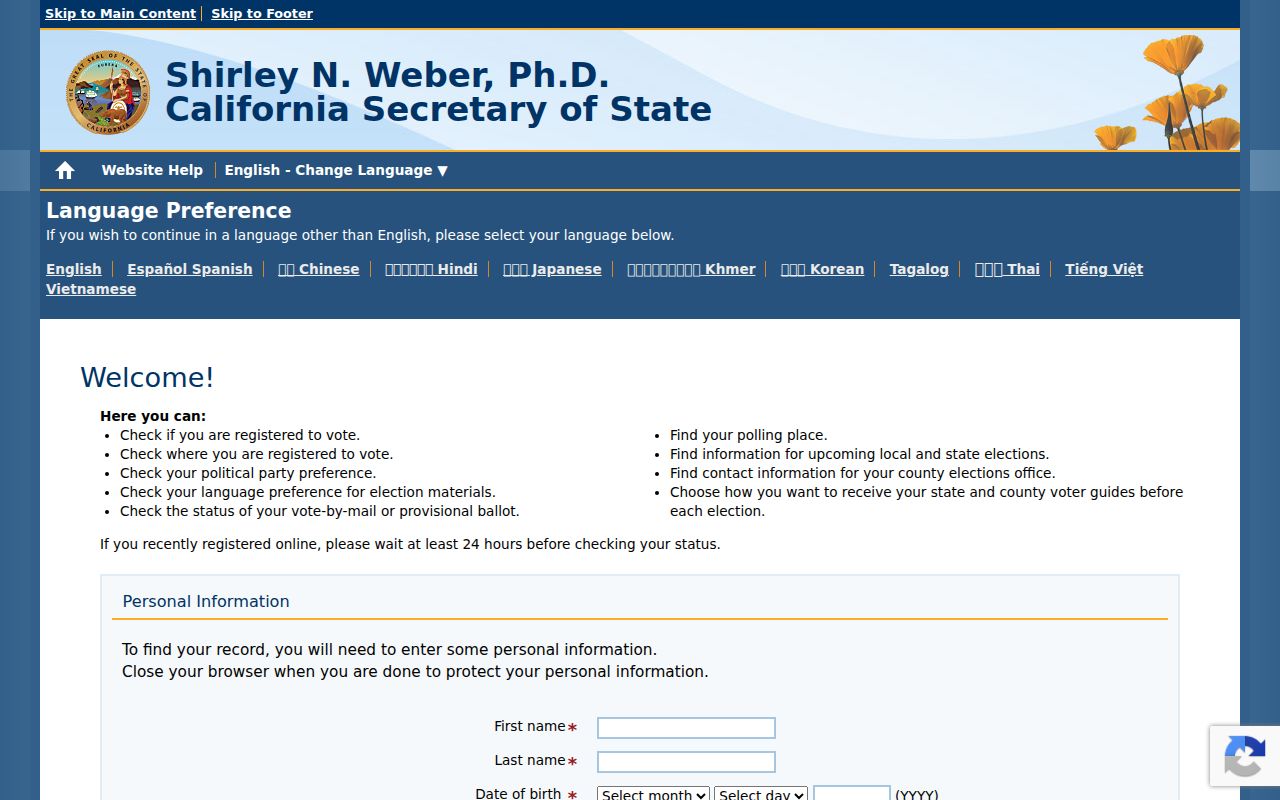
Match the official form's fields exactly, and honor the purpose limits attached to any voter-file request. A failed self-check proves nothing about whether someone still lives in Costa Mesa.